A wire fraud victim discovers their business was tricked into sending $500,000 to attackers. The funds were immediately converted to cryptocurrency. Is the money gone forever?
Not necessarily.
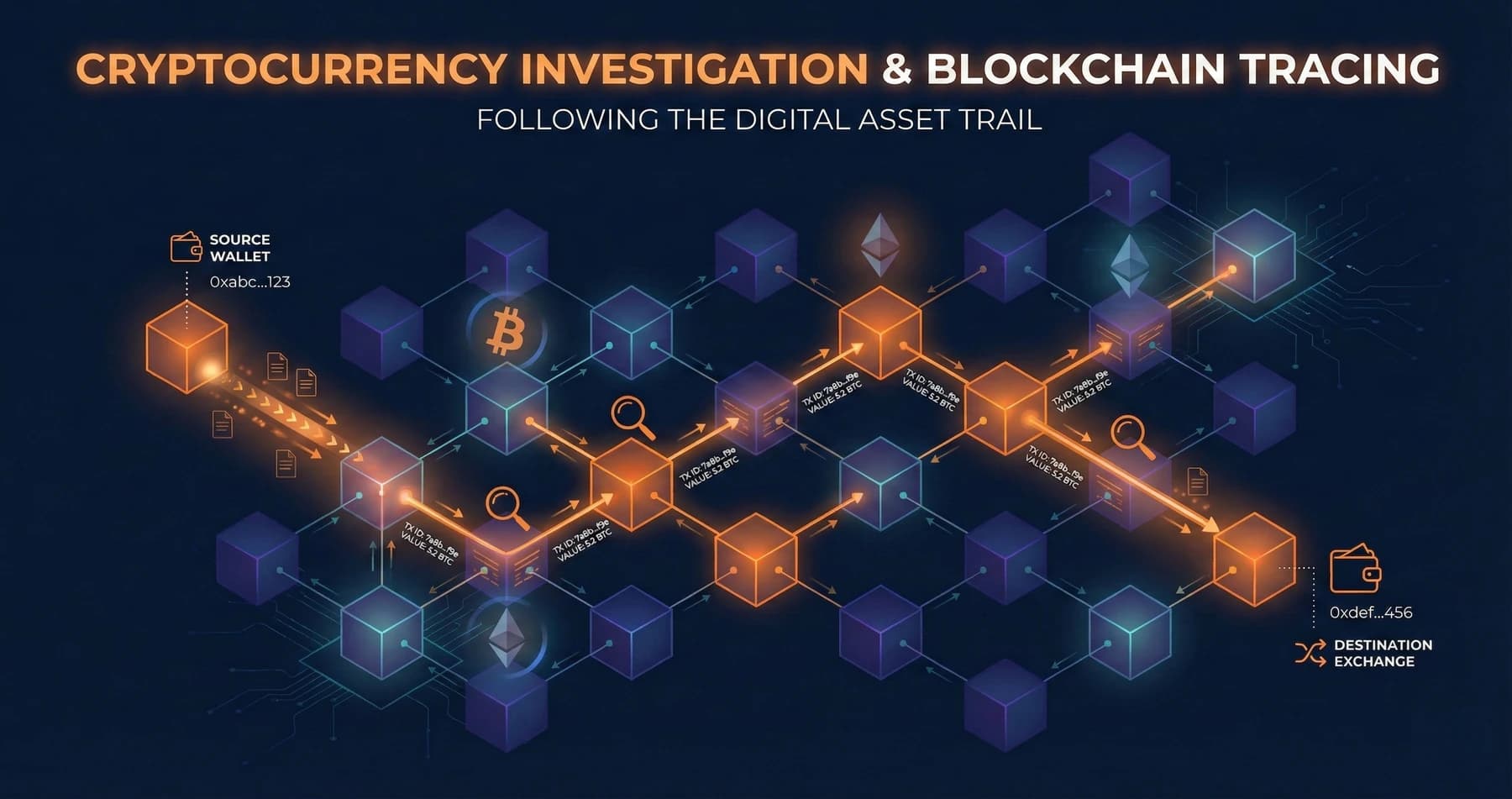
Blockchain technology creates a permanent, public record of every transaction. While criminals exploit cryptocurrency for its pseudonymous nature, that same blockchain becomes a forensic goldmine for investigators who know how to read it.
Blockchain Analysis Fundamentals
Before diving into investigation techniques, understanding blockchain basics is essential:
The Public Ledger
Bitcoin, Ethereum, and most major cryptocurrencies maintain public blockchains. Every transaction is recorded and visible to anyone. While wallet addresses aren't inherently linked to real identities, the transaction history is completely transparent.
Addresses vs. Identities
A cryptocurrency address is a string of characters that represents a destination for funds. A single person or entity can control multiple addresses. The challenge of blockchain investigation is linking addresses to real-world identities.
Transaction Structure
Cryptocurrency transactions show:
- Source address(es)
- Destination address(es)
- Amount transferred
- Timestamp
- Transaction fees
This information, combined with additional context, enables tracing.
Immutability
Once recorded on the blockchain, transactions cannot be altered or deleted. This means investigative evidence is permanently preserved, even if criminals try to "clean" their trail.
Common Cryptocurrency Theft Scenarios
Understanding attack patterns helps focus investigation:
Business Email Compromise (BEC) with Crypto Conversion
Attackers trick businesses into wire transfers, then quickly convert funds to cryptocurrency to prevent recovery through traditional banking channels.
Investigation focus: Identify the initial crypto purchase, trace from there.
Exchange Account Compromise
Attackers gain access to victims' exchange accounts and transfer assets to attacker-controlled wallets.
Investigation focus: Trace from the compromised exchange account.
Ransomware Payments
Victims pay ransomware demands to attacker wallets, often in Bitcoin or Monero.
Investigation focus: Trace ransom wallet to identify cashout points.
Investment Fraud
"Pig butchering" and other scams convince victims to send cryptocurrency to fraudulent investment platforms.
Investigation focus: Trace from victim deposits through the fraud infrastructure.
DeFi Exploits
Smart contract vulnerabilities are exploited to drain decentralized finance protocols.
Investigation focus: Trace from the exploit transaction through laundering attempts.
The cryptocurrency investigation field has matured significantly. Professional-grade blockchain analytics tools can now trace funds through hundreds of transactions, identify connections between seemingly unrelated wallets, and often link addresses to real-world entities.
Tracing Techniques
Blockchain investigators use multiple approaches to trace stolen funds:
Transaction Graph Analysis
Follow the money by mapping transaction flows:
- Start with known attacker address (from theft transaction)
- Trace all outbound transactions
- Identify patterns in fund movement
- Continue until funds reach identifiable endpoints
Challenges:
- Funds may split across hundreds of addresses
- Mixing services attempt to break transaction links
- Cross-chain bridges move funds between blockchains
Clustering Analysis
Cryptocurrency users often control multiple addresses. Clustering techniques identify addresses likely controlled by the same entity:
Heuristics include:
- Multi-input transactions (addresses used together in a transaction are likely same owner)
- Change address patterns
- Timing patterns in transactions
- Amount patterns suggesting automated systems
Exchange Identification
Major cryptocurrency exchanges implement Know Your Customer (KYC) requirements. When funds reach an exchange, investigation can potentially identify the account holder through legal process.
Identifying exchange deposits:
- Known exchange deposit address patterns
- Transaction behavior characteristic of exchanges
- Volume and timing patterns
Timing Analysis
Transaction timing reveals information:
- Time zone inference from activity patterns
- Coordination between addresses suggesting common control
- Response patterns to external events
Amount Analysis
Transaction amounts provide signals:
- Round number transactions (psychological patterns)
- Amounts matching known prices or conversions
- Fee patterns suggesting specific wallet software
Working with Law Enforcement and Legal Teams
Cryptocurrency investigation often requires coordination with legal counsel and law enforcement:
Evidence Preservation
Blockchain evidence must be documented properly:
- Capture transaction data with timestamps
- Screenshot relevant blockchain explorer views
- Document methodology and tools used
- Maintain chain of custody for all evidence
Legal Process
Recovering funds typically requires legal action:
- Subpoenas to exchanges for account holder information
- Asset freeze requests where funds are identified
- Civil litigation to recover assets
- Criminal referrals for law enforcement investigation
Law Enforcement Coordination
Many law enforcement agencies now have cryptocurrency expertise:
- FBI has cryptocurrency investigation units
- Secret Service handles financial crimes including crypto
- Many state and local agencies have trained investigators
- International cooperation through INTERPOL and bilateral agreements
Exchange Cooperation
Exchanges vary in their responsiveness to legal requests:
- Major US exchanges generally cooperative with valid legal process
- International exchanges may be slower or unresponsive
- DeFi protocols have no entity to serve legal process
- Timing is critical because funds must be present when freeze request arrives
What Makes Assets Recoverable (vs. Truly Lost)
Not all stolen cryptocurrency can be recovered. Understanding the factors helps set realistic expectations:
Favorable Factors
Funds at regulated exchanges: If stolen funds reach an exchange that complies with legal process, recovery is possible through asset freeze and seizure.
Identifiable perpetrators: When investigation identifies the attacker, civil and criminal remedies become available.
Rapid response: The faster investigation begins, the more likely funds are still traceable and haven't been cashed out.
Clean transaction trail: Direct transfers without mixing or complex laundering are easier to trace.
Challenging Factors
Privacy coins: Monero and similar privacy-focused cryptocurrencies are designed to prevent tracing. Recovery is extremely difficult.
Mixing and tumbling: Services that mix funds from multiple users break transaction trails. Sophisticated mixing can make tracing practically impossible.
Cross-chain movement: Funds moved across multiple blockchains through bridges complicate investigation.
Jurisdictional issues: Funds reaching exchanges in uncooperative jurisdictions may be unrecoverable through legal process.
Time delay: The longer between theft and investigation, the more opportunity attackers have to launder and cash out.
Be wary of "recovery services" that guarantee return of stolen cryptocurrency. Many of these are scams that prey on theft victims a second time. Legitimate investigation provides no guarantees, only assessment of what's possible given the specific circumstances.
Preventive Measures for Crypto Holders
Prevention is far more reliable than recovery:
Exchange Security
- Enable all available security features (MFA, withdrawal allowlists, etc.)
- Use hardware security keys where supported
- Set withdrawal delays for large amounts
- Regularly review authorized sessions and API keys
Wallet Security
- Use hardware wallets for significant holdings
- Never enter seed phrases digitally
- Maintain secure offline backup of recovery information
- Consider multisignature wallets for large amounts
Transaction Security
- Verify addresses multiple times before sending
- Start with small test transactions for new recipients
- Be extremely skeptical of "support" contacts initiated by others
- Never share screen during crypto transactions
Operational Security
- Use dedicated devices for crypto management
- Be cautious about revealing holdings publicly
- Understand that cryptocurrency transactions are generally irreversible
When to Engage Investigation Services
Consider professional cryptocurrency investigation when:
Significant value is at stake: Investigation costs should be proportional to potential recovery.
Law enforcement needs support: Many agencies lack deep cryptocurrency expertise and welcome expert assistance.
Civil litigation is planned: Expert analysis provides evidence for legal proceedings.
Insurance claims require documentation: Thorough investigation supports insurance claims for covered losses.
Understanding the attack is important: Even without recovery, understanding how theft occurred prevents future losses.
The Investigation Process
A typical cryptocurrency investigation proceeds:
1. Initial Assessment
- Review available information about the theft
- Identify known attacker addresses
- Assess likelihood of meaningful recovery
- Establish scope and timeline
2. Blockchain Analysis
- Trace funds from theft through subsequent transactions
- Identify clustering and connection patterns
- Determine where funds currently reside
- Identify exchange touchpoints
3. Attribution Research
- Correlate blockchain findings with open source intelligence
- Identify potential attacker identities or locations
- Document connections between addresses and entities
4. Reporting and Evidence Package
- Document findings in format suitable for legal proceedings
- Prepare materials for law enforcement referral
- Support legal counsel with technical expertise
5. Ongoing Monitoring
- Continue watching attacker addresses for movement
- Alert if funds move to recoverable locations
- Update analysis as new information emerges
The Bottom Line
Cryptocurrency is not the untraceable criminal paradise it's sometimes portrayed as. Blockchain forensics has become a sophisticated discipline that regularly traces funds and supports recovery efforts.
However, recovery is never guaranteed. The pseudonymous nature of cryptocurrency, combined with mixing services and uncooperative jurisdictions, means some stolen funds remain beyond recovery.
If you've experienced cryptocurrency theft, rapid engagement of qualified investigators improves the chances of meaningful recovery. And for those holding significant cryptocurrency assets, robust security measures are far more reliable than after-the-fact investigation.
Related Service
Learn more about how we can help with Digital Forensics & Investigations.
Explore Digital Forensics & Investigations Services →