On the night of October 11, attackers hijacked refrigeration controllers at French supermarkets and raised store temperatures by triggering the built-in defrost function. French outlets reported between 250 and 350 stores affected. Further refrigeration incidents were reported across Europe on November 2 and 3, with SentinelOne's timeline listing Belgium, Estonia, Germany, Ireland, Italy, Luxembourg, the Netherlands, Portugal and Sweden. In Finland, the retailer Kesko reported temperature anomalies at a few smaller stores but had not confirmed a cyberattack. Stores pulled food. On November 2, the cold room control systems at three sites of the French blood service were tampered with.
The reported damage came from changed settings on refrigeration controllers.
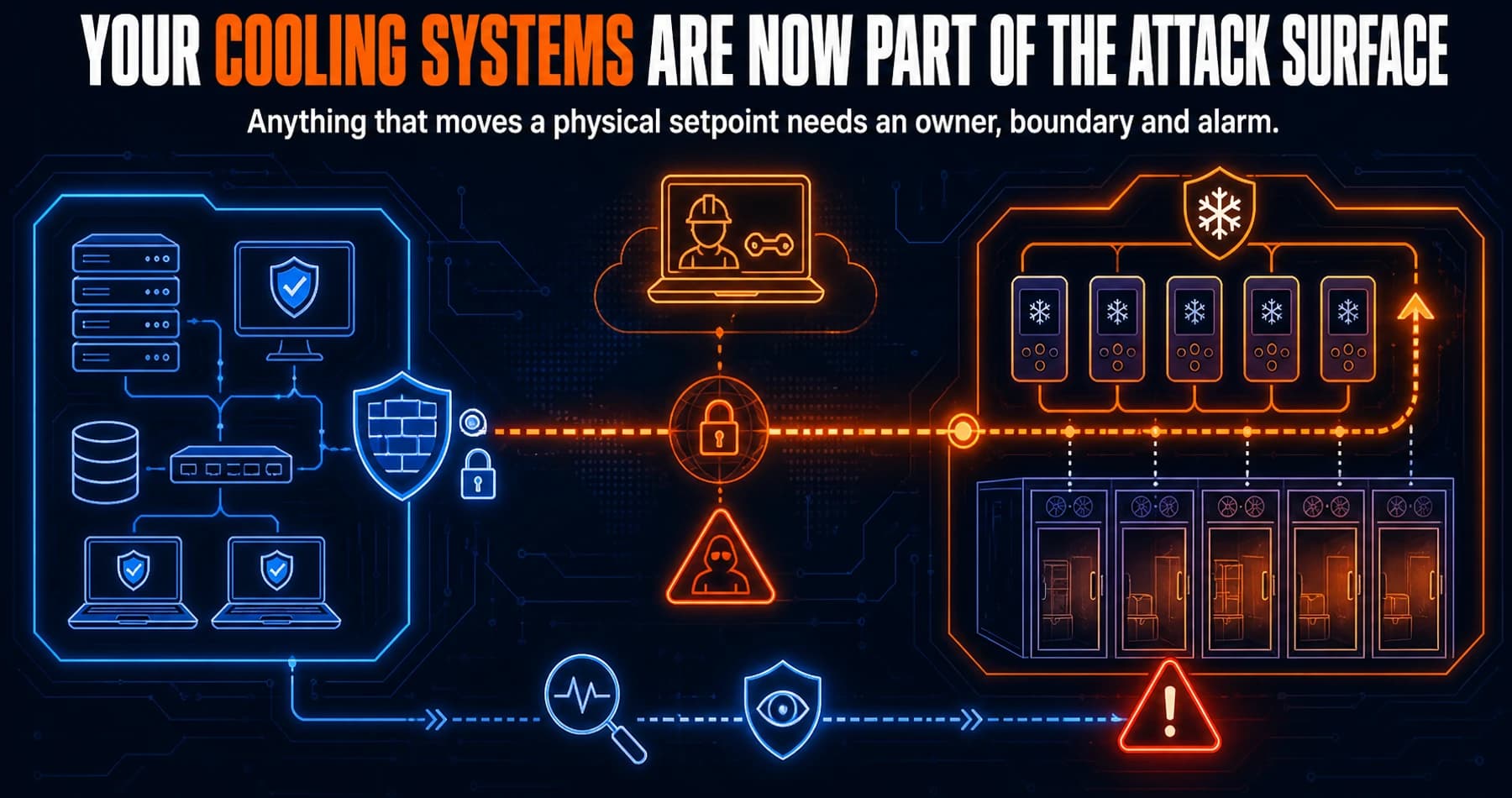
The uncomfortable part is who owns that device. Responsibility may sit with facilities, a refrigeration contractor or another operational team. It was installed so someone could check temperatures from a phone or so a technician could adjust a defrost schedule without driving to the site. Devices like this are easy to leave out of an asset inventory and a segmentation plan, and the contractor who maintains one may never have gone through your vendor access review. Check whether yours are covered, and establish who owns and administers each controller.
What Happened to the Fridges
The French Computer Emergency Response Team, CERT-FR, issued alert CERTFR-2026-ALE-012 on October 12. It updated the alert on October 13 to add more targeted equipment and on October 16 to update its recommendations. It reports numerous compromises of remote refrigeration controllers and lists Danfoss AK-SM and AK-SC series, Copeland xweb and Dixell xweb equipment as affected. It says exposing a management interface to the internet goes against good practice and that the campaigns are probably ongoing.
Danfoss told the trade publication Cooling Post that most affected units were legacy products or current products running outdated firmware. The legacy models, the AK-SM 800 declared end of life in 2021 and the AK-SC 355 phased out in 2016, no longer receive software or security updates. For the second wave, a Danfoss spokesperson told Dutch broadcaster NOS that the Dutch systems affected were not on a secure network and still used default passwords. Intermarché described its incident as an attack reportedly affecting a service provider that manages refrigeration systems in stores.
The Etablissement français du sang (EFS), the French blood service, said that on November 2, temperature and defrost thresholds on cold storage at three of its sites were set to very high temperatures. The cold rooms held bags of plasma for transfusion or for processing into medicines. EFS says its refrigeration equipment supplier was compromised, not EFS directly. Its monitoring and alarm systems detected the change quickly, and staff either repaired the equipment or moved products to other facilities. EFS reported no health impact and no loss of blood products.
As of November 4, claims attributed to the hacktivist groups NoName057(16) and Z-Pentest had circulated, but SentinelOne researchers noted that they had not been independently verified. Responsibility remains unestablished, and Belgium's national cybersecurity authority has said it may never be determined who is responsible. The US government has not attributed the activity either. Attribution is the wrong thing to wait for. The method works against anyone with the same exposure.
Why Washington Issued a Warning
On November 5, the Cybersecurity and Infrastructure Security Agency (CISA), the FBI, the Department of Health and Human Services (HHS), the US Department of Agriculture (USDA) and the Department of Transportation (DOT) published a joint fact sheet, US Government Partners Urge Hardening Industrial Refrigeration and Cold Chain Monitoring Systems, urging operators to harden industrial refrigeration and cold chain monitoring systems. It says the agencies are aware of malicious cyber activity targeting these systems globally.
The sectors named are Healthcare and Public Health, Chemical, Food and Agriculture, and Transportation Systems, including refrigerated transport. The systems in scope handle remote temperature monitoring, continuous logging, defrost cycle management and energy optimization.
The fact sheet describes actors who may exploit weaknesses in unpatched or internet-accessible controllers to alter settings remotely and force units into continuous heating and defrost cycles. The outcomes it lists are inventory loss, equipment hazards, reduced equipment service life, a possible fire hazard, and indirect harm to consumers if product is eaten after unsafe storage. It also names loss of visibility into current temperatures, which it calls a denial of view condition.
Chris Butera, CISA's acting cybersecurity chief, told TechCrunch that every organization that depends on refrigeration and monitoring systems should assume it could be a target. The fact sheet does not name a confirmed US victim. The warning is about exposure, and exposure is something you can measure today.
The Controller Nobody on the Security Team Owns
Ask three people who owns the refrigeration controller at a store, a cold room or a pharmacy back room. The facilities manager says the contractor. The contractor says the facilities manager. The security team says it never saw that one.
The pattern is not carelessness. These devices may be purchased through facilities projects or maintenance contracts rather than IT procurement. They often come with remote access so a contractor can monitor and adjust them. A refrigeration contractor monitoring many sites needs reachability, and some installations exposed management interfaces directly to the internet.
The result is a class of asset with properties that make it attractive to an attacker. It is reachable from outside, because remote monitoring was the point. It can fall outside the IT patch process, and some of the units hit in France were older models their maker no longer updates. And changing its settings can produce physical consequences, including unsafe storage temperatures and inventory loss.
The segmentation plan fails for the same reason. If the device is not in the inventory, it was never assigned to a zone. It can end up on whatever switch the installer chose, including the business network.
Find Them Before Someone Else Does
Start with discovery from three directions, because no single source is complete.
First, ask facilities and your refrigeration contractors for a list of every controller, monitoring gateway and data logger, with site, model, firmware and how it reaches the internet. Expect the first list to be wrong. Ask again with the contractor's service records in hand.
Second, look at your own network. Controllers show up in DHCP leases, in switch port tables and in the traffic that leaves a store or warehouse. Look for devices from the vendors named in the CERT-FR alert, and for any site that talks to a monitoring cloud.
Third, check what the internet can see of you. Search your public address ranges and any addresses your contractors use on your behalf for management interfaces. A controller that answers a stranger is the first thing to fix.
Every asset that survives this exercise gets a named owner, a site, a model, a firmware version and a support status. The support status matters most, and we will come back to it.
Put a Boundary Around Them
The fact sheet's mitigations line up with the CISA and NIST Cross-Sector Cybersecurity Performance Goals, and the first one is blunt. Eliminate public internet exposure of control devices, especially controller panels. Where remote access is necessary, protect it with an up-to-date firewall or edge device.
Then isolate. Put operational technology (OT), meaning equipment that controls a physical process, on a dedicated virtual LAN (VLAN), separate from business networks, so a compromised point of sale terminal cannot reach a controller and a compromised controller cannot reach anything else. Use device and IP allowlisting to limit who can make changes. Change default passwords, strengthen passwords, and use phishing-resistant multifactor authentication (MFA) wherever the platform supports it.
CERT-FR adds a practical sequence. Remove internet exposure first, and restore remote access only through a secure VPN or a protected network. Filtering the contractor's source addresses at a firewall is an emergency measure only, not a lasting one. Review the full configuration before returning anything to service, especially defrost schedules, and reconfigure compromised equipment rather than assuming it is clean.
Contractor Access Is Vendor Access
The Intermarché and EFS statements both point at the same thing. The compromise reportedly sat with a service provider or supplier, not with the retailer or the blood service itself. That is the vendor access problem you already know from software, just with a compressor attached.
Treat the refrigeration contractor like any other third party with remote reach. Ask how they connect, from where, with what credentials, and whether those credentials are unique per customer. Ask whether their access is logged and whether you can see the log. Ask what happens to your sites if their platform is compromised. Put the answers in the contract.
The goal is that a breach at your contractor does not give an attacker a path to your controllers. That means the contractor connects into a boundary you control, with named accounts and MFA, instead of through a standing public door.
Alarms Are Your Last Control
Prevention will fail somewhere, so the alarm has to work independently of the thing being attacked.
The EFS case is the model. Temperature and defrost thresholds at three cold storage sites were set to very high temperatures, and monitoring and alarm systems detected it quickly. Staff repaired equipment or moved product to other facilities, and EFS reported no loss of blood products. The change was real, and the alarms still did their job.
The fact sheet tells operators to define reasonable setpoint limits and alert on deviations. Do it at two levels. The first is the controller's own alarm, which tells a person on site that a cold room is warming. The second is an independent signal, such as a battery-powered probe or a separate monitoring system on a different network path, that does not depend on the controller's reported values. The fact sheet lists loss of visibility into current temperatures as a possible effect, so a monitor that reads from the controller alone can go blind exactly when it matters.
Also alert on the configuration, not only the temperature. A changed defrost schedule is an early signal and arrives before the product warms. Where the controller does not log in a form your tools understand, the fact sheet says to collect network traffic between assets instead.
Finally, decide who gets paged at 2 a.m. and what they are authorized to do. Moving product is a business decision, and it should be made by someone who has already been told they can make it.
Plan for End of Life Hardware
Danfoss said most units hit in France were legacy products or current products on outdated firmware, and the legacy models no longer receive security updates.
CERT-FR warns that keeping an end of life (EOL) device without security fixes exposed to the internet carries a very high risk of compromise. A factory reset alone is insufficient. It removes the persistence but leaves the device vulnerable, so it will likely be compromised again.
That changes the economics. For an unsupported controller there is no patch to wait for. The choices are to remove it from the internet and wall it off, or to replace it. Your inventory needs a support status column, and every EOL unit needs a replacement date attached to a budget line.
The fact sheet asks for structured lifecycle management to identify, retire and replace EOL devices, along with current, offsite, offline and tested backups. A tested backup of a controller's known good settings turns a recovery from a site visit full of guesswork into a restore.
Where Teams Get It Wrong
The first mistake is treating this as a facilities problem. Facilities owns the equipment, but facilities was never given a network design, a patch process or a log pipeline. Security has to own the boundary and the monitoring even if it does not own the device.
The second is trusting the contractor's word that it is handled. Ask for evidence, such as the firewall rule, the access log and the firmware version.
The third is fixing only the sites you know about. The refrigeration at a distribution center, a pharmacy, a hospital kitchen or a lab freezer farm is often bought separately from the stores. Inventory by function, not by department.
The fourth is letting alarms depend on the same path as the control. And the fifth is waiting for attribution or a CVE number before acting. The CERT-FR alert names no CVE, and the Dutch systems Danfoss described were exposed and still on default passwords.
Related Service
Learn more about how we can help with Security Architecture & Advisory.
Explore Security Architecture & Advisory Services →Where to Start This Week
Get a list of every refrigeration and cold chain monitoring controller from facilities and your contractors, and name an owner for each. Search your public address space for management interfaces and close any you find. Move whatever remains onto its own VLAN with a firewall in front. Ask each contractor how they connect to you and whether that access can be tied to named accounts. Confirm that someone is paged when a setpoint or defrost schedule changes.
If you see signs of compromise, the fact sheet lists where to report. CISA's 24/7 Operations Center takes reports by email at contact@cisa.dhs.gov or at 1-844-Say-CISA (1-844-729-2472). The FBI takes reports through its Internet Crime Complaint Center (IC3) or your local field office. HHS wants to hear about health and medical supply chain disruption at HHSCyber@hhs.gov or 202-619-7800.
Cold rooms hold the product your business sells and the medicine your patients need. They deserve the same discipline as a database.