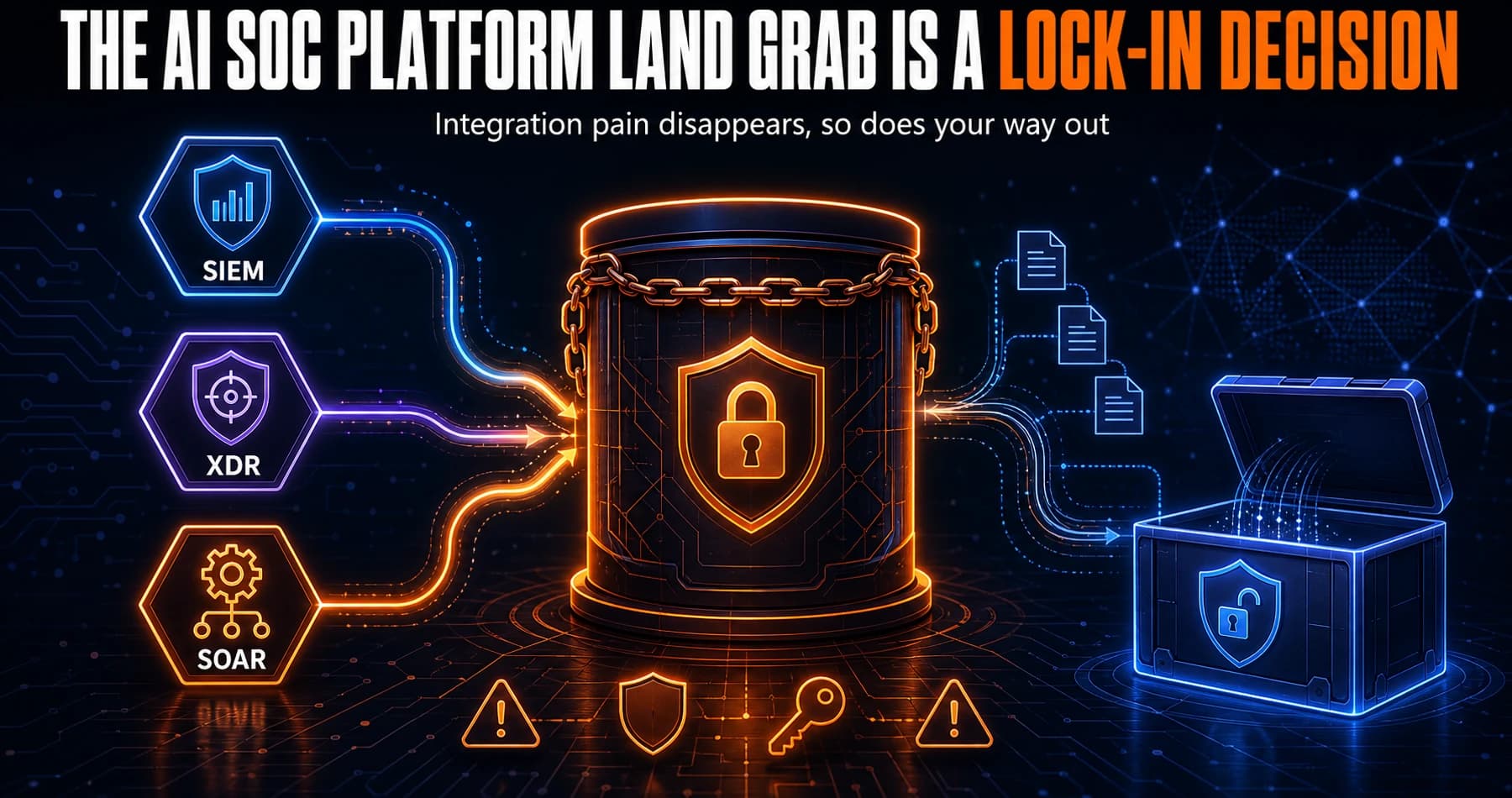
Every major SOC vendor is telling the same story right now. Stop stitching together a SIEM, an XDR, and a SOAR from three different companies. Buy one platform that already does all three, with AI layered on top to triage the alerts a human used to have to read first. Palo Alto Networks folded IBM's QRadar SaaS customers into Cortex XSIAM after acquiring those assets in 2024, with the acquired QRadar SaaS products scheduled to reach end of life by April 2026. Microsoft merged Sentinel and Defender XDR into one unified security operations portal, with a single incident queue and a single set of automation playbooks. Google rebranded Chronicle into Google Security Operations and unified its SIEM and SOAR consoles into one detection, investigation, and response workspace.
The pitch is consistent across all three. One data model instead of three. One place to write a rule instead of stitching API calls between tools that were never designed to talk to each other. Faster time to detection because the XDR signal and the SIEM correlation happen in the same place instead of bouncing through a SOAR playbook to connect them.
That pitch is mostly true. It is also a lock-in decision dressed up as an architecture upgrade, and most security leaders are evaluating it purely on the first half.
Why this is happening now, and why it is harder to resist than the last consolidation wave
SOC tool sprawl has been a problem for a decade. What changed is that AI-assisted triage needs a single, consistent view of alert, identity, and log data to work well. A model trying to correlate an XDR detection with SIEM telemetry across a brittle API integration produces worse output than the same model working inside one platform's native schema. So the vendors building AI SOC features have a real technical reason to push everything into one data model, not just a licensing reason.
That reason is legitimate, and it raises the cost of staying split. A multi-vendor stack now means your AI triage layer, if you want one, has to reconcile schemas the vendors never intended to be reconciled. The commercial side pushes the same direction. IBM Consulting is offering eligible QRadar SaaS customers a direct migration path onto Cortex XSIAM ahead of the end-of-life date, which turns a voluntary evaluation into a deadline. Microsoft and Google have each folded what used to be separate SIEM and SOAR consoles into one interface by default, so staying split now means actively choosing to run the older, separated view.
The result is that teams who would have resisted a single-vendor pitch five years ago are saying yes now, because the AI features genuinely work better integrated and the renewal conversation makes staying split look like the expensive, worse option. That is a reasonable trade to make. It is not a trade to make without understanding what you are giving up.
What you actually lose, and what you keep if you plan for it
The real cost of consolidation is not the contract. It is where your detection logic and your log data end up living.
Detection logic written natively lives in the vendor's query language. Splunk SPL, Microsoft KQL, and Google SecOps YARA-L are not interchangeable, and a detection rule written in one does not run in another without a rewrite. If every analytic your team has tuned over three years exists only as native KQL inside Sentinel, moving to a different platform does not mean exporting your detections. It means rebuilding them, testing them against new data, and relearning which ones were tuned to suppress a specific noisy source in your environment. That rebuild is where migrations actually lose time, not in moving the raw logs.
Log data has the same problem one layer down. Most AI SOC platforms want your telemetry inside their proprietary store, because that is what their correlation engine and their AI features are built against. Retention windows, query performance, and even what counts as a searchable field are controlled by the vendor. If you decide to leave, your historical data either stays behind, or it is exportable only at a cost and a pace the vendor sets, not you.
The fix is not refusing to consolidate. It is treating detection logic and raw log storage as assets you own, separate from the platform you operate them through.
For detection logic, author new detections in Sigma, the open-source rule format most of the industry has converged on, and keep them in version control like any other code. Treat the vendor's native query language as a compile target, not the source of truth. A Sigma rule converts to SPL, to KQL, to YARA-L, or to whatever the next platform uses with a translation step, not a rewrite from scratch. The mapping is not always one-to-one and some conversions need manual review, but you are editing a translation, not reconstructing institutional knowledge about why a rule was written a certain way.
For log data, keep a parallel copy of raw telemetry in an open columnar format such as Parquet on cloud object storage you control, rather than treating the vendor's ingestion pipeline as your only copy. Normalizing that data to a shared schema like OCSF, the Open Cybersecurity Schema Framework, means it stays queryable and detection-compatible even if you change which platform sits on top of it.
What this looks like day to day
In practice this is a two-track workflow. Your detection engineers write and review Sigma rules in a git repository, with pull requests, version history, and test cases, exactly like application code. A conversion step, whether a vendor-provided translator or an open-source one, generates the native rule for whatever platform is primary today. The native rule is a build artifact. The Sigma rule is the source.
A detection engineer who needs a new rule for impossible-travel logins writes it once in Sigma, converts it to KQL for Sentinel this quarter, and ships the same Sigma file through a different converter the day a migration lands on YARA-L instead. The rule does not get rewritten. Only the compile step changes.
For data, high-value logs such as authentication, endpoint, identity provider, and cloud control plane activity get a parallel export to object storage in Parquet, tagged and normalized to OCSF where the source supports it. This does not replace the vendor's ingestion. It runs alongside it, and it gives you a second copy you control for threat hunting, compliance holds, and the day you negotiate a renewal from a position of actually having somewhere else to go.
Before signing or renewing any AI SOC platform contract, put three questions to the vendor in writing. Can you export the full history of your log data in a standard, non-proprietary format, and what does that cost. Are detection rules portable as Sigma or an equivalent open format, or do they only exist as native query language that has to be rewritten to leave. And walk through an actual exit, not a hypothetical one, including how long it takes and what breaks during the transition.
Read the export terms for historical log data before you sign, not after you decide to leave. Some platforms charge far more to export years of retained logs than they ever charged to ingest them, and that bill arrives exactly when you have the least leverage to negotiate it.
Where teams get this wrong
The most common mistake is treating detection as code as a nice-to-have that gets skipped under deadline pressure, so the Sigma layer quietly falls out of sync with what is actually running in the platform. Months later nobody trusts the Sigma repository and the native rules are the only truth, which defeats the entire point.
The second mistake is assuming the parallel data export is a one-time project. Source schemas drift, new log sources get added natively without a corresponding OCSF mapping, and the export silently stops covering what the SOC actually depends on. Portability has to be a standing requirement in the onboarding checklist for new log sources, not a project that ships once and gets forgotten.
The close
Consolidation is not the mistake. Most SOCs genuinely benefit from one data model and fewer brittle integrations, and the AI triage features are real enough to justify the move for a lot of teams. The mistake is letting the platform become the only place your detection logic and your log history exist. Keep the Sigma rules in version control and the raw logs in open storage, and the single-vendor platform stops being a trap and starts being what it was actually pitched as, a faster way to run the SOC you already have.
Related Service
Learn more about how we can help with Security Engineering.
Explore Security Engineering Services →