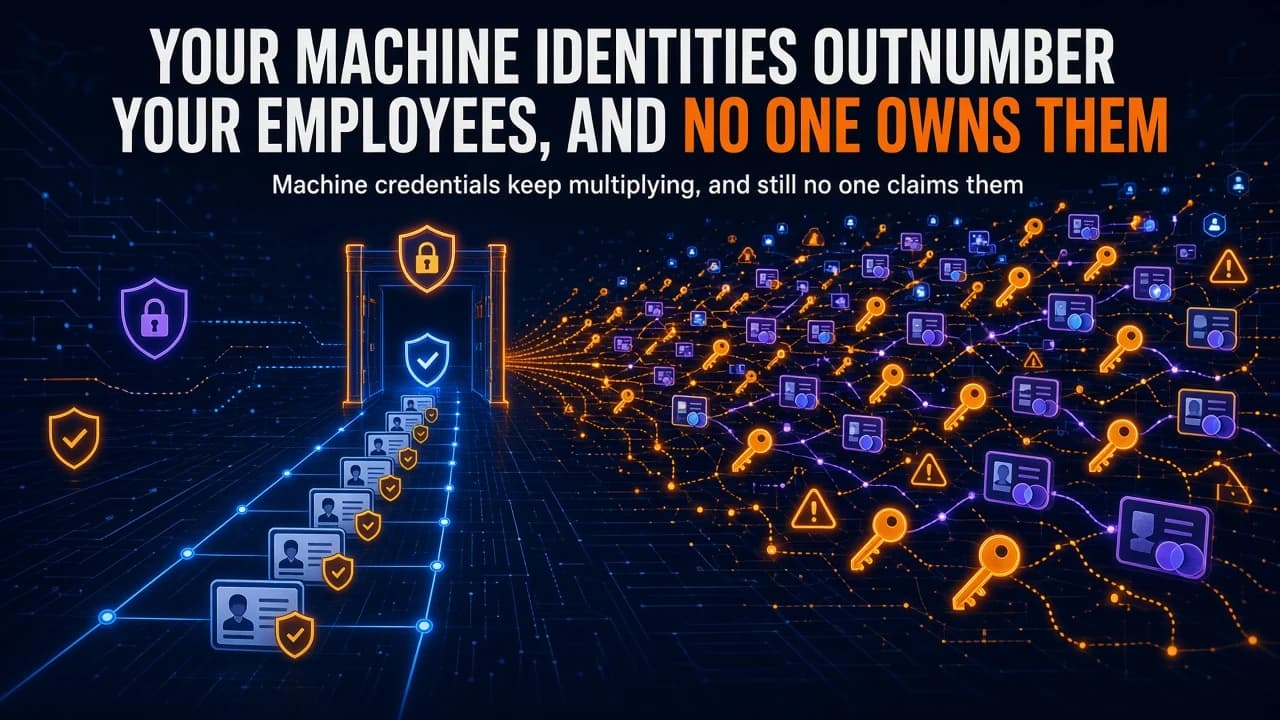
Every enterprise now has more machine identities than human ones. Service accounts, API keys, OAuth tokens, and workload identities tied to cloud IAM roles dwarf the employee headcount they were built to serve. Most security teams can describe exactly how a person gets promoted to domain admin, how long that access lasts, and who signed off on it. Ask the same team how many API keys their finance integration has generated this year, who owns each one, or what happens to a key when the engineer who created it leaves, and the room goes quiet.
That gap has existed for years and mostly went unpunished because most non-human identities sat still, doing one narrow job, rarely touched by an attacker who had easier ways in. Autonomous AI agents change that math. An agent is not a static integration calling the same three endpoints forever. It requests new credentials, chains tool calls across systems, and acts on its own schedule with nobody watching the session in real time. The discipline enterprises built for privileged human access, and mostly skipped for machines, is now the only thing standing between a useful automation and an unsupervised, credentialed actor nobody can name the owner of.
The Population Nobody Provisioned For
Cloud native architecture broke the old model first. Every microservice, CI/CD runner, SaaS to SaaS integration, and container workload needs its own identity, and most of them got provisioned the way engineers provision anything under deadline pressure. Quickly, broadly scoped, and never revisited again. Industry estimates put the ratio of non-human to human identities at somewhere around 45 to 1 across the average enterprise, and considerably higher inside cloud native and DevOps environments, where some research puts it well over 140 to 1. The population behind that ratio has grown fast, with multiple industry reports describing machine identity counts climbing several times over across the last five years as cloud adoption accelerated.
AI agents are what turn that backlog into an emergency. In a well built system, an agent requests a credential at runtime, uses it for one task, and the credential expires within minutes. In practice, a lot of agents shipped in the last year still authenticate the way a script written a decade ago did, with a static key pasted into an environment variable or a config file. Researchers who track exposed credentials on public code repositories reported close to 29 million newly exposed hardcoded secrets on public GitHub in 2025, a year over year increase of roughly a third, and found that a majority of secrets leaked years earlier were still valid and usable when they checked again in early 2026. Long lived credentials do not get safer with age. They get forgotten.
Governing An Identity That Never Sleeps
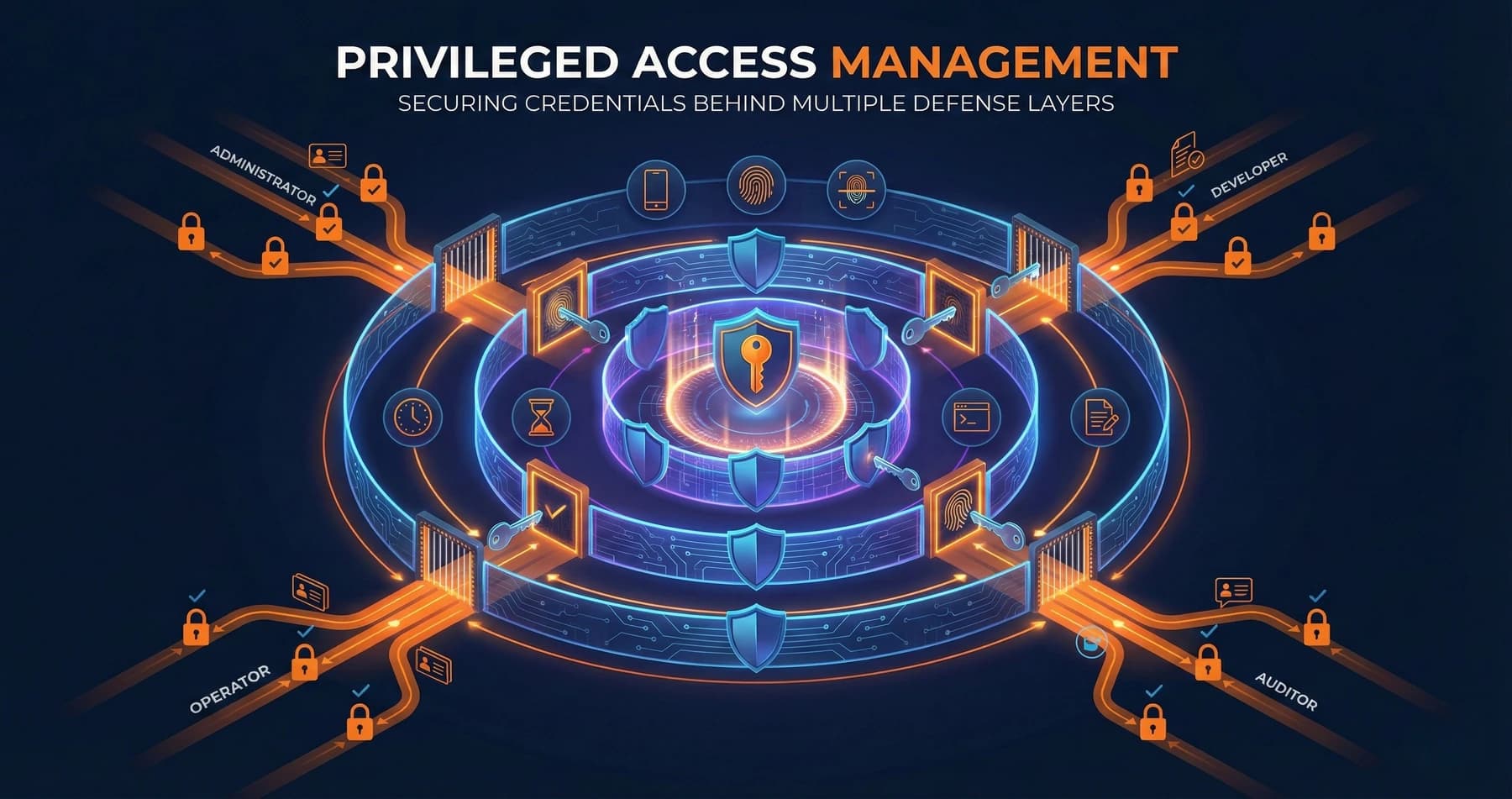
Privileged access management already solved this problem once, for humans. A privileged human account has a named owner, a defined lifecycle, least privilege scoping, forced rotation, and a deprovisioning trigger tied to HR. None of that is exotic. It took most enterprises a decade of audit findings to build. Machine and agent identities need the same five things. The only real difference is where the trigger for each one comes from.
Ownership has to be a hard gate, not a courtesy. Every service account, API key, OAuth grant, and agent credential needs a named human or team recorded at the moment it is issued, the same way a privileged human account needs a business justification before it gets provisioned. An identity nobody owns is an identity nobody notices when it starts behaving badly, because there is no one whose job it is to notice.
Least privilege gets skipped for machine identities more often than for human ones, because scoping a token narrowly takes an extra engineering step and a broad token avoids a follow up access request later. That shortcut is exactly what makes a compromised or misused non-human identity so expensive. A credential that can only touch the one resource it needs limits how far an attacker or a misbehaving agent can go with it. A credential provisioned broadly out of convenience turns one leaked key into access far outside the job it was ever meant to do.
Picture a build pipeline whose deploy key was scoped broadly during setup because narrowing it would have meant coordinating with three other teams. Two years later nobody remembers why the key can reach every environment instead of just staging. That gap sits quietly until something, a leaked log line, a compromised dependency, or a misconfigured agent, finds it before anyone else does.
Rotation and offboarding are where the agent problem gets sharp. OWASP maintains a risk framework specifically for non-human identities, and its headline categories read like a checklist of what agent credentials tend to get wrong first, improper offboarding, leaked secrets, over privileged access, and credentials that live far longer than the task that needed them. Static, long lived API keys are still the default way many agents authenticate today, because scoped, short lived credentials require infrastructure most teams have not built yet. One 2026 industry survey found that a large share of organizations still rely on static API keys as the primary credential mechanism for their AI agent population, and a separate 2026 Cloud Security Alliance survey found that most organizations could not trace agent actions back to an accountable human sponsor at all. Workload identity federation and short lived, scoped credentials exist to close exactly this gap. The Model Context Protocol's specification revision in November 2025 added explicit OAuth authorization server requirements for exactly this reason, but most agent deployments today still authenticate with personal access tokens or developer issued keys that never touch that governance layer.
A static API key handed to an autonomous agent with no assigned owner is a standing privileged session that nobody is watching. Unlike a stolen human password, there is no unusual login to flag. The agent misusing that key looks exactly like the agent doing its normal job, which means the control has to sit upstream in governance, not downstream in monitoring that was never built to catch it.
What This Looks Like In Practice
The fix is not a new discipline. It is extending the PAM muscle most enterprises already built for humans to cover the population that now dwarfs them.
| Human privileged access practice | Non-human identity equivalent |
|---|---|
| Named owner and business justification before provisioning | Named sponsor and purpose recorded at credential issuance, enforced as a gate rather than a suggestion |
| Just in time elevation instead of standing admin rights | Short lived, scoped tokens through workload identity federation instead of static keys |
| Deprovisioning triggered by HR offboarding | Deprovisioning triggered by project end, repository archival, or agent decommission |
| Session recording and periodic access review | Every action logged and attributed back to the sponsoring human or team |
| Credential vaulting with enforced rotation | Secrets management with enforced rotation and no hardcoded keys in code or configuration |
Start with discovery, and treat it as continuous rather than a one time project. You cannot govern an identity you do not know exists, and new ones appear every time a developer connects a SaaS tool or an agent gets a new integration. Route every new service account, API key, and agent credential through the same governed issuance path your PAM platform already uses for privileged human access, rather than letting teams self provision through a cloud console. Where the platform supports it, make short lived federated credentials the default and treat a request for a static, long lived key as an exception that needs sign off, not the default path.
Related Service
Learn more about how we can help with Identity & Access Management.
Explore Identity & Access Management Services →Where Teams Get It Wrong
The most common mistake is treating this as a tooling purchase. A non-human identity discovery platform will show you the sprawl. It will not assign ownership, and it will not decide who is accountable when an over scoped agent credential does something it should never have been able to do. That is an organizational decision, and skipping it is how an expensive discovery dashboard ends up with nobody acting on what it finds.
The second mistake is running two separate identity programs. A mature one for humans, and an informal, spreadsheet and ticket process for everything else, treated as normal because it has always worked that way. Machine identities are not an edge case anymore. They are the majority of the identity population, and a PAM program that still treats them as technical plumbing rather than governed identities in their own right is protecting a shrinking share of the actual attack surface.
The third is approving agent pilots with broad, static credentials because scoping them properly would slow the pilot down, then never circling back once the pilot quietly becomes production without anyone updating its access.
Start With Ownership, Not Tooling
None of this requires inventing a new security discipline. It requires applying the one enterprises already built for privileged human access, ownership, lifecycle, least privilege, rotation, and offboarding, to a population that has grown faster than headcount ever did and now mostly runs itself. Organizations that already run a mature PAM program have a head start, because the pattern transfers directly once someone decides to apply it. The ones still treating service accounts as an engineering detail nobody owns will find that gap tested long before they finish writing the policy meant to close it.