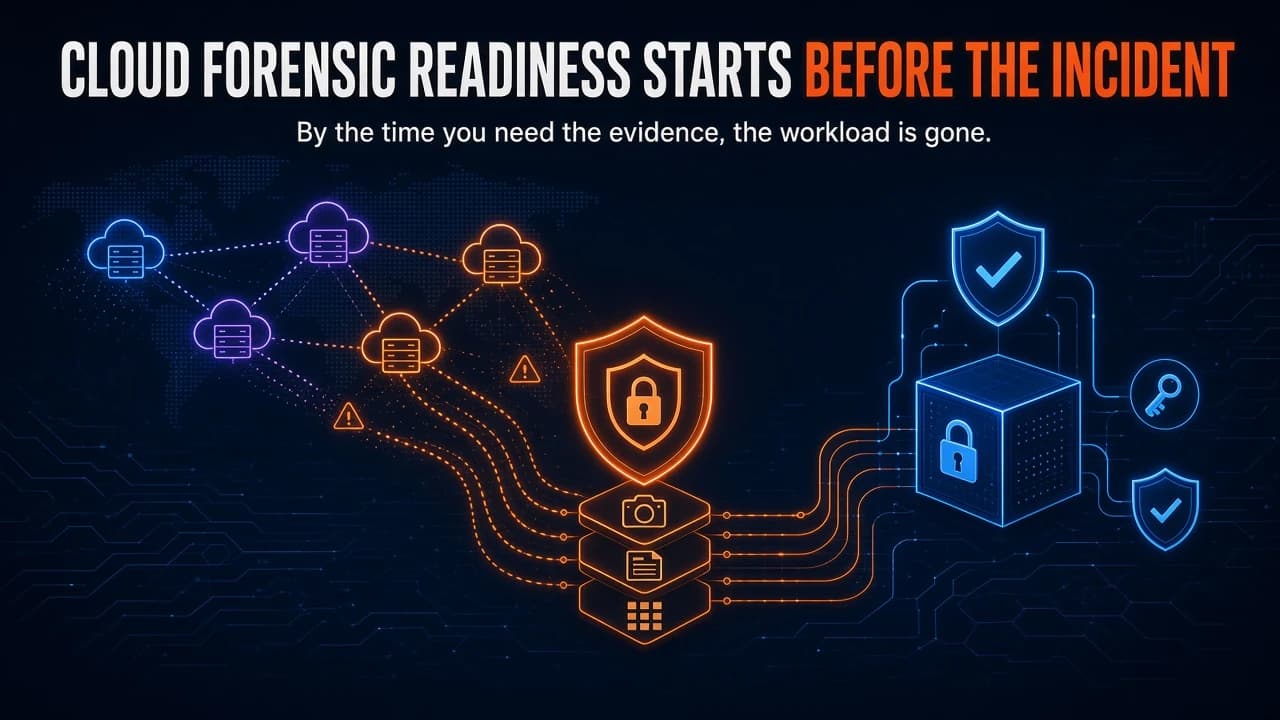
By the time an incident response team realizes it needs forensic evidence from a cloud workload, the workload is usually gone. The container that ran the malicious process terminated on schedule. The auto-scaling group cycled out the compromised instance hours ago. The SaaS vendor's default log retention window closed before anyone thought to ask for a copy. None of this is unusual. It is cloud infrastructure doing exactly what it was built to do, and it is exactly why evidence collection breaks down when an organization treats cloud forensics as something to figure out after the alert fires.
On-premises forensics assumes a disk you can pull, a machine you can image, and a custody log you control end to end. Cloud environments remove all three assumptions. You do not own the hardware. You do not always control when a resource is destroyed. And a meaningful share of your evidence sits inside a third party's logging pipeline, subject to that party's retention defaults, export limits, and legal process requirements, not yours.
None of that means cloud evidence is unrecoverable. It means the work of making it recoverable has to happen before an incident, as a deliberate configuration and contracting exercise, not as an improvised ask to a cloud support queue at 2 a.m.
Why this gets harder every year
Compute lifespans keep shrinking. A serverless function might run for milliseconds. A container might live for a single job. Autoscaling groups replace instances routinely, and immutable infrastructure practices mean a compromised host is often redeployed clean rather than patched in place, which destroys the very artifact an investigator would want to examine. None of that is a security failure. It is the point of the architecture. But it means volatile evidence that used to survive on a physical server until someone got around to it now has a shelf life measured in minutes.
Multi-cloud and SaaS sprawl compound the problem. A mid-sized environment can easily touch a dozen or more platforms, each with its own audit log format, its own default retention period, and its own mechanism, or lack of one, for exporting raw events rather than a summarized report. Enabling logging is not the same as retaining it, and retaining it inside the provider's console is not the same as owning a copy your investigators can search after the provider's default window closes.
The shared responsibility model that governs security controls does not map cleanly onto evidentiary responsibility. A provider will secure the hypervisor and the physical layer, but it decides what telemetry about that layer you get to see, and multi-tenancy is the reason. Giving one customer raw access to underlying host activity risks exposing another customer's workload on the same hardware, so providers gate that access behind their own support and legal processes, not yours.
What actually breaks down during a real investigation
The order of volatility that guides evidence collection, memory before network state before disk, still applies in the cloud, but the methods change. You cannot walk over and pull a live memory dump off a shared hypervisor. You depend on the provider's own snapshot and imaging APIs, and those only capture what they were designed to capture. A memory-resident credential harvester might be invisible to a disk snapshot taken after the fact if nobody triggered a memory capture before the instance terminated.
Access limits are the second failure point. Packet capture at the network layer, which used to be trivial with a mirrored switch port, requires the provider's own traffic mirroring feature, and that feature has to already be turned on. Host-level forensic access to the underlying infrastructure is simply not something a tenant gets, full stop, no matter how serious the incident.
Every capability worth having here becomes available only if somebody turned it on before the incident. Flow logs, traffic mirroring, and forensic grade export tiers are all configuration decisions made in calm conditions. Walk your estate and write down, account by account, which of them are enabled today. That list is your real forensic capability, not the one in the vendor datasheet.
Third-party chain of custody is the failure point that surprises legal counsel the most. When a SaaS vendor's own support staff pull logs on your behalf, your custody chain now includes a custodian you did not choose, whose collection process you cannot independently verify, and whose staff may not testify to how the export was generated. Some platforms do not offer a forensic-grade export at all, only a dashboard or an aggregate report, which is not the same evidentiary object as a raw, timestamped event log with a hash you can validate.
The table below is a rough guide to where the evidence actually lives, by service model.
| Service model | What you can usually get | What you usually cannot get directly |
|---|---|---|
| IaaS | Disk snapshots, VM images, provider audit logs such as CloudTrail, Activity Log, or Cloud Audit Logs, network flow logs if enabled in advance | Hypervisor and physical host telemetry, memory captures unless snapshotted before termination |
| PaaS | Platform-level access and configuration logs, application logs you route to your own storage | Underlying compute and orchestration internals, which the provider manages entirely |
| SaaS | Admin activity logs and audit trails, if the vendor's tier includes export | Raw event-level data on most standard tiers, and any log the vendor did not choose to retain or expose |
A preservation request sent to a cloud or SaaS provider is not the same as a legal hold. Most providers require a formal legal process, not a support ticket, before they will freeze or produce data. Get counsel involved in that conversation before an incident, not during one.
What readiness looks like in practice
Readiness starts with an inventory. List every cloud and SaaS service in scope, and for each one, document what evidence it can produce, in what format, retained for how long, and what has to happen to get a copy out. Most organizations discover this inventory does not exist until they need it, which is the wrong time to find out.
From there, three things need to happen before an incident, not during one. First, route provider-native audit logs, the CloudTrail, Activity Log, or Cloud Audit Logs equivalent, into storage you control, with a retention period matched to your actual investigation and legal-hold timelines rather than the provider's out-of-the-box default. Second, build snapshot and disk imaging into your incident response automation itself, so a compromised instance gets imaged the moment containment triggers, before an autoscaling policy or a scheduled redeploy tears it down. Third, put evidentiary language into cloud and SaaS contracts at signing time, covering data preservation on request, cooperation with legal process, and export format, rather than discovering the vendor's limitations after a subpoena is already in motion.
Test all of it. A tabletop exercise that asks whether your team can retrieve a specific log entry or snapshot within your actual retention window, using the access and process you actually have, will surface gaps that a policy document never will.
Where organizations get this wrong
The most common mistake is treating the provider's default log retention as a backup, then discovering it aged out before anyone asked for a copy. Close behind it is assuming a support request will freeze data the way a legal hold does, when most providers require formal process before they act. Organizations also tend to treat every cloud service the same, applying an infrastructure mental model to a SaaS platform that never offered raw export in the first place. And contracts get signed without security or legal reviewing what happens to evidence during an incident, so the first time anyone reads the data processing agreement closely is after something has already gone wrong.
The work has to happen now
None of this is glamorous. It is log routing, retention configuration, contract line items, and runbooks nobody reads until the day they matter. But it is the difference between an investigation that produces a documented, defensible record of what happened and one that produces a shrug because the evidence expired, terminated, or lived inside a provider nobody thought to ask in advance. Build the readiness now. There is no version of this that works if you start during the incident.
Related Service
Learn more about how we can help with Digital Forensics.
Explore Digital Forensics Services →