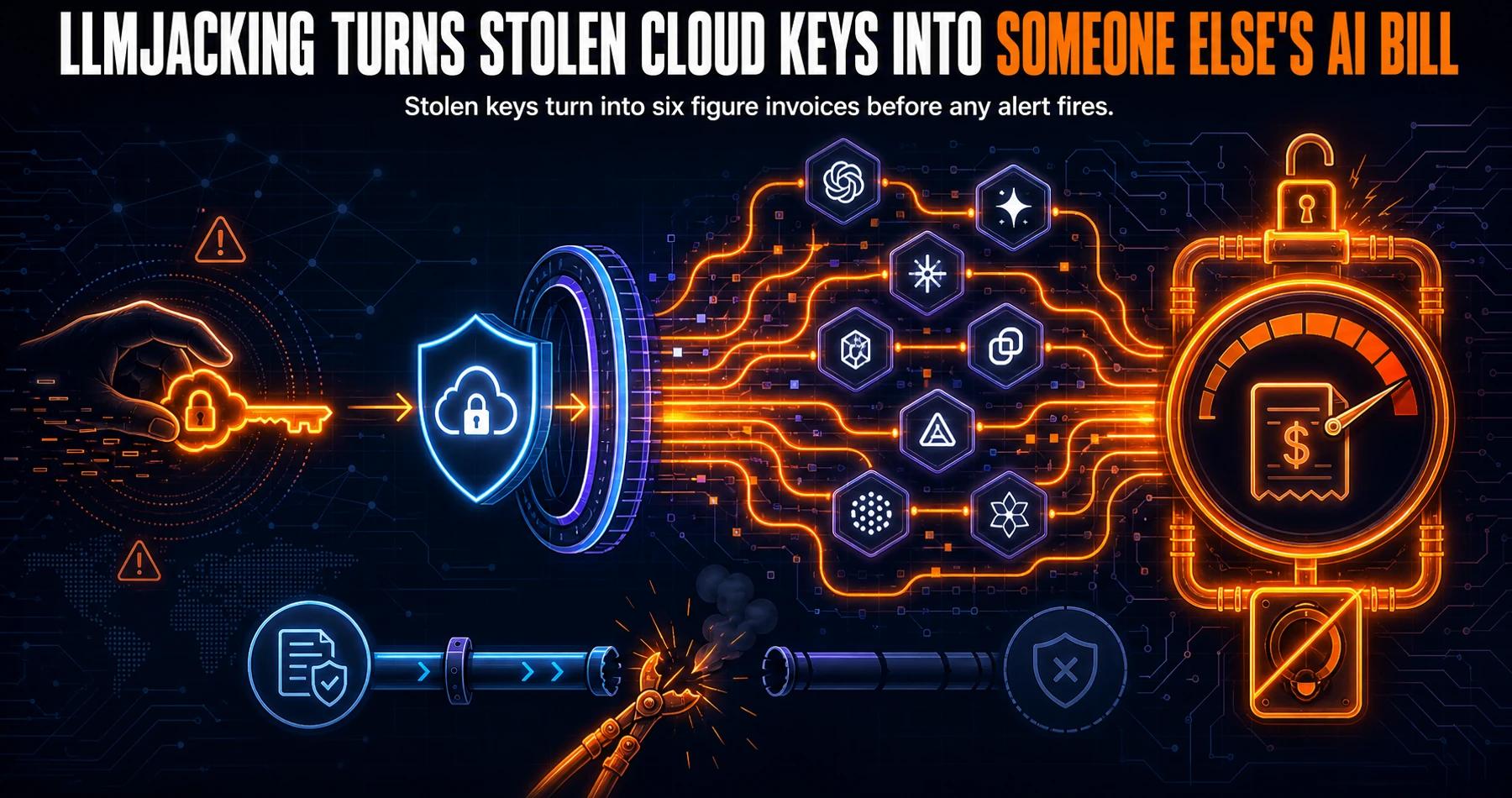
You may learn about your next cloud compromise from the finance team. Nobody on the security side will have seen an alert. An invoice shows up with a line item for an AI service you never meant to buy. Someone used your stolen cloud keys to run AI models on your account, and the number has a lot of zeros.
That is the pattern Google Threat Intelligence Group (GTIG) and Mandiant describe in a November 2, 2026 report on LLMjacking. A large language model (LLM) is the engine behind tools like chatbots and code assistants. LLMjacking means an attacker uses your cloud account to run those models and leaves you with the bill. Mandiant responded to multiple incidents in 2026 where fraudulent charges passed $100,000 in a single day. At some organizations the cumulative total reached $1 million before access was revoked.
The uncomfortable part is who is exposed. It is not only the teams building AI products. If a stolen key can switch an AI service on, your organization is a target whether or not anyone there has ever opened a model console. Model usage is now a security signal worth collecting.
What LLMjacking Is and Why It Pays Better Than Cryptojacking
Sysdig's Threat Research Team coined the term in May 2024. They watched attackers use cloud credentials stolen from a system running a vulnerable Laravel version to reach ten cloud-hosted LLM services. Sysdig estimated the worst-case cost to the victim at more than $46,000 per day, and said the attackers appeared to intend to sell that access to other criminals while the account owner paid.
Cryptojacking, where an attacker runs cryptocurrency mining software on hijacked compute, is a slow drain. The bill grows steadily and often hides inside normal growth. LLMjacking behaves differently. GTIG reports large spikes in charges within hours, and it expects actors to increasingly favor LLMjacking over cryptojacking.
What Mandiant Found in 2026
The victims were in North America, South America, and Asia Pacific. They worked in financial services, retail, technology, and transportation, and they ran on a variety of cloud and model providers. No single platform or sector was the common thread.
The common thread was speed and scale. Single-day charges above $100,000 were seen in individual incidents. Persistence went beyond a stolen key. Attackers created unauthorized admin identity and access management (IAM) accounts, injected SSH keys, and set up backdoor service accounts disguised as internal billing optimization utilities. One actor used a burn and rotate approach, cycling through accounts to get around rate limits.
GTIG also recommends watching for attempts to view, alter, or disable model invocation logging configuration. That logging is the one record that would show what an intruder is doing with your models, so any change to it deserves a second look.
It Starts With an Identity Problem
This is not an AI vulnerability. GTIG found the dominant initial access vector was exposed or stolen cloud identity tokens. That includes IAM credentials, service account keys, GitHub personal access tokens, and active session tokens. Mandiant also saw corporate LLM application programming interface (API) keys harvested from public GitHub repositories, and model endpoints exposed to the internet.
The session token case deserves attention. In mid-2026 one active cloud intrusion cluster tracked by GTIG compromised a cloud instance through a misconfigured service account key. It also ran a page masquerading as an application portal for joining a group of LLM users. The page had visitors paste a raw JSON payload that contained an active access token. A token already represents a completed login, so the attack bypassed password and multifactor authentication (MFA) controls entirely. That cluster accumulated more than $100,000 in billing charges in one victim's projects.
One actor using a service called Jet Night made more than 500,000 LLM API calls in under eight hours. Nearly one million dollars in token costs landed on the victim organization. Jet Night offered an unlimited plan for about $60 per month, against a typical $100 to $250 per month for consumer services. GTIG believes a price like that only works if the operator relies on stolen keys.
Not Using AI Does Not Protect You
In multiple incidents, LLM services were not enabled at the time of compromise. The attackers used the stolen access keys to enable services such as Amazon Bedrock and the Gemini API, then generated enormous bills in minutes or hours. One actor subscribed victim accounts to pay-as-you-go agreements so that usage would be billable immediately.
That changes the risk conversation. Many security leaders have a mental list titled "our AI exposure" and it contains the tools their employees use and the models their developers call. The real exposure is wider. It is every identity in your cloud environment that holds permission to enable a service and accept its terms.
The sharpest risk is an attacker turning on a model service you have never used, and then turning off the logging that would show it. GTIG recommends treating unauthorized enablement of LLM services as a critical security event, and treating calls to disable model invocation logging by anyone outside your infrastructure as code pipeline as high severity. If neither of those fires an alert today, you may find out from the invoice.
The Resale Economy Behind the Bill
GTIG describes illicit routing gateways it calls LLM Mixers. They proxy, aggregate, and resell unauthorized model access to underground subscribers. They pool stolen credentials, meter usage, and obscure the origin of requests. The people who steal the keys are often not the people who spend them. GTIG sees a division of labor between initial access operators and monetization operators.
That explains the speed. A key is not a prize to be held for a rainy day. It is inventory, and the buyers are already waiting.
Microsoft's Digital Crimes Unit described the same economy in February 2025. Its Storm-2139 case involved exposed customer credentials scraped from public sources, used to reach generative AI accounts, alter what the services could do, and resell access to other actors. Microsoft filed suit in December 2024 in the Eastern District of Virginia and later named four defendants in an amended complaint.
Self-hosted infrastructure is part of the picture too. A follow-on cluster abused an organization's LiteLLM gateway, an open source AI gateway, by exploiting its key management to elevate ordinary virtual keys to full admin. Gateways hold many keys in one place, which makes them a good target. They belong in patch management and key rotation like any other internet-facing system.
Why Your SOC May Not See It Yet
Your security operations center (SOC) can only alert on what is recorded, and the most detailed records are off by default. AWS documentation states that Amazon Bedrock model invocation logging is disabled by default. Once enabled, it sends logs to CloudWatch Logs or Amazon S3, and each record carries the calling principal along with input and output token counts. That is exactly the data you need to separate a developer experiment from a stranger burning tokens.
Google Cloud is similar. Its audit documentation says that except for BigQuery, Data Access audit logs are disabled by default because they can generate large volumes of data. GTIG notes that the Data Access logs needed to see Vertex AI predictions are among them. Azure is split. Platform metrics, including request and token usage, are collected automatically, but resource logs are not stored until you create a diagnostic setting.
Some visibility does arrive without any setup. Bedrock publishes invocation counts and input and output token counts to CloudWatch, broken out by model, and Azure collects comparable metrics in Azure Monitor. Those numbers can show a spike well before the invoice does, if someone is watching them. What they cannot tell you is which identity made the calls. That takes the detailed logs. Detection here comes down to a handful of event families.
The first is service enablement, especially for AI services in accounts or projects that never used them. The second is model access agreements and pay-as-you-go subscriptions. The third is changes to logging configuration for model invocation. The fourth is new keys, new admin accounts, and new service accounts, particularly ones with innocuous names. The fifth is invocation volume that departs from a baseline, including from principals that have never called a model.
Controls That Shrink the Blast Radius
GTIG's mitigations are mostly ordinary identity hygiene applied with some urgency. Centralize secrets management and automate rotation, so a leaked key has a short life. Apply least privilege that denies every permission not explicitly required, including access to cloud LLM services. Scan code repositories for secrets automatically. Require phishing-resistant MFA across all cloud identity providers.
Then add the controls specific to models. Set granular API quotas and spending caps on LLM services. Restrict API keys by model, environment, and usage limit. Use posture management tools to discover shadow LLM use you did not know about. Patch LLM gateways such as LiteLLM.
The spending cap deserves emphasis because a cap that is actually enforced limits the financial loss even after other controls have failed. Quotas on requests and tokens help in the same way. Neither is a guarantee if the attacker holds permission to raise it, so treat changes to quotas and caps like changes to logging. A budget alert that sends an email is not a cap. Know which of your cloud accounts can actually stop spending and which can only notify.
Where Teams Get It Wrong
The first mistake is leaving model spend with finance. A monthly review of the cloud bill is a detection control with a thirty-day delay, and these incidents run for hours.
The second is assuming a no-AI policy is a control. A policy is a statement of intent. The attacker's access key does not read it. If the permission exists, the service can be enabled.
The third is treating MFA as a closed question. Tokens pasted into a fake portal bypass it, so phishing-resistant MFA, short token lifetimes, and monitoring for unusual session use all matter. The fourth is assuming that logging will be there when needed. Logging is a configuration that anyone with the right permission can change, so it needs the same change control as the production systems it watches.
The last is forgetting the gateway. An internal AI gateway is a credential vault with a web interface. If it is not in your patch cycle and your rotation schedule, it is a way in.
Where to Start This Quarter
First, turn on the logs. Enable Bedrock model invocation logging and Google Cloud Data Access logs for model services, and create Azure diagnostic settings. Accept the storage cost, scoped to the services in question. While you wait for those logs to accumulate, put alerts on the request and token metrics the platforms already collect.
Second, write the two alerts GTIG calls out. Unexpected enablement of an LLM service should page someone. Any change to model logging from outside your infrastructure as code pipeline should be high severity.
Third, put an explicit deny on model services for every identity that has no reason to call them. This protects the organization that has never used AI as much as the one that uses it daily.
Fourth, set hard quotas and spending caps, and check that they work. Finally, find where your keys live. Repositories, build systems, and the gateways in front of your models are the first places to look.
The lesson from Mandiant's 2026 incidents is narrow and practical. Stolen cloud keys can turn into fraudulent AI charges within hours. The defense is not a new category of tool. It is identity discipline, a few logs you have to switch on, and two alerts worth writing this week.
If you cannot say today which of your cloud identities could enable a model service, start there. That answer is the gap.
Related Service
Learn more about how we can help with Security Operations.
Explore Security Operations Services →