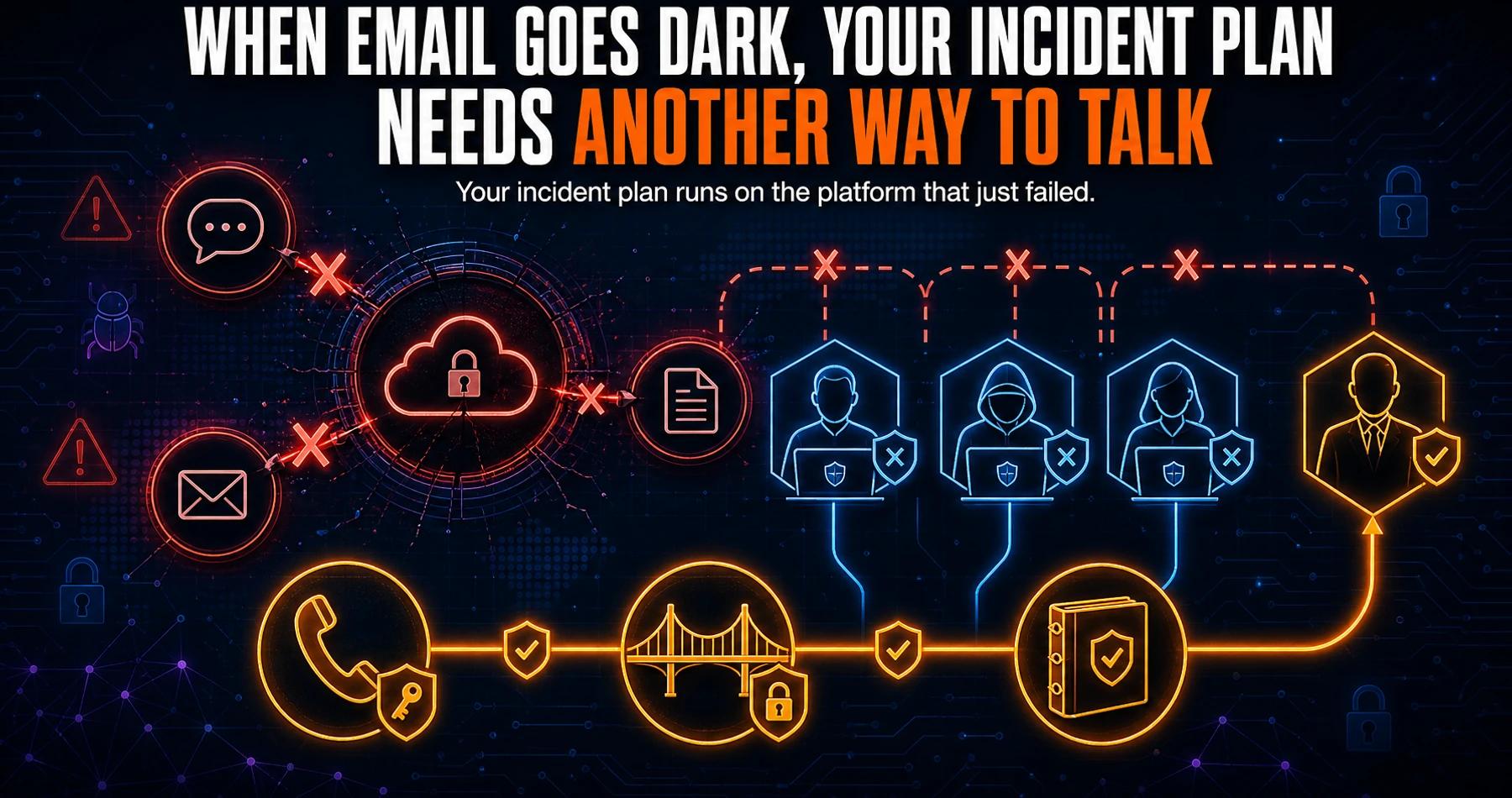
On Thursday, November 12, a Microsoft outage disrupted Outlook, Teams, Copilot and other Microsoft 365 services for organizations around the world. Microsoft said it was "a technical issue not related to cyber or AI / agents," introduced by "an issue during an earlier network capacity upgrade." In Japan, the government said authorities had taken steps including securing alternative communication tools such as telephones.
That detail is worth copying, and the outage is a good prompt for a harder question. What would your incident response plan (IRP) run on if your collaboration platform disappeared in the middle of an incident?
The Platform Is Usually Part of the Plan
Look at where your response actually lives. Paging often rides on email or a chat integration. The war room is a Teams channel or a meeting link. The runbooks, the contact roster and the decision log sit on SharePoint or another shared drive. Approvals for isolating a system or taking a service offline get requested and granted in an email thread. Status updates to executives, staff and customers go out from the same tenant.
None of that is careless. It is what happens when one platform is good at everything. The cost is correlation. One failure takes out the business and the response together, and a ransomware attack or a compromised tenant can do that as thoroughly as a vendor outage, with an adversary who may be reading along.
The test for a security leader is simple. If email, chat and file sharing vanished right now, who would you call, how would you reach them, and who could approve a containment decision? If the honest answer is "we would find out," the plan has a hole in it.
Outage or Attack, the Same Gap Appears
A vendor failure and a hostile intrusion share a first symptom. In an outage, the channel is unavailable. In a compromise, it is unavailable or, worse, available and watched.
Government guidance treats the second case as a security problem, not only a continuity problem. A joint advisory from the Cybersecurity and Infrastructure Security Agency (CISA) and partner agencies lists communicating over the same network as the incident response among the common mistakes in incident handling. The #StopRansomware Guide recommends out-of-band methods such as phone calls so that you do not tip off attackers that they have been discovered. CISA's federal incident response playbooks call for phone bridges and a method for out-of-band coordination.
The takeaway is that an out-of-band channel, one that runs entirely outside the systems you are defending, is more than a continuity measure for the day a vendor has a problem. It is an operational security control for the day an attacker has your tenant.
What an Out-of-Band Channel Needs to Do
This is a set of requirements, not a product recommendation. Any tool that meets them will do, and a tool that fails them is worse than none because it creates false confidence.
Who is on it. Name the incident commander, the technical leads, an executive decision maker, legal, communications and a representative from each critical business function, each with an alternate. Keep the group small enough to talk and large enough to decide. CISA's Communicating Under Pressure guidance calls for a cross-functional incident team with primary and alternate points of contact, and for keeping contact lists updated. Stale lists fail first, so give one person ownership of keeping this one current.
How people join. Assume corporate laptops and corporate accounts are unavailable or untrusted. Members need to be able to join from a personal phone or a separate device, with access set up in advance. If joining requires a password nobody has memorized, a hardware token left at the office or an app that was never installed, it will not work at the moment it matters.
How identity is verified. On an open call during an incident, anyone can claim to be anyone, and a familiar number on the screen proves nothing. Do not act on an incoming call because the caller ID looks right. Hang up and call the person back at the number on your offline roster. Apply the same rule to sensitive approvals, such as isolating a production system. The incident commander places the callback, hears the approval directly and records who approved what and when. Treat anyone who joins the bridge unexpectedly as unverified until someone on the roster confirms them the same way.
Independence from the primary tenant. The channel must not depend on the platform it backs up. That means separate accounts, a separate sign-in path and no reliance on the primary identity provider or single sign-on (SSO), the system that lets one login unlock many applications. Phones are not automatically independent either. If company calling runs through Teams Phone or another service that signs in through the same identity provider, or the bridge number lives only in a calendar invite, the phone fails with everything else. Choose numbers, a calling service and a bridge that keep working without the primary tenant, the corporate network or company devices, and keep the dial-in details somewhere people can reach offline.
Here is what a dependency check looks like in practice. For each tool on the backup list, ask how people sign in, where their contact details come from and what device they use. A common finding is a backup chat workspace that signs in through the same SSO as the main tenant. If the identity provider is down, nobody gets in. If it is compromised, an attacker holding stolen credentials may be able to join and read along. The Kansas Office of the State Bank Commissioner's incident response guidance recommends out-of-band communications precisely to keep threat actors from using SSO to reach containment and remediation efforts.
One more requirement is cultural. The channel should be boring to use. If the first time anyone touches it is during a crisis, the learning curve is paid for in minutes you do not have.
Decisions Need a Path Too
Communication is only half the problem. The other half is authority. In an outage, the people who can approve a costly decision may be unreachable, and teams will either freeze or improvise.
Write down who can decide what, and what happens if they cannot be reached. Pre-agree the authority to isolate a system, to take a customer-facing service offline, to engage outside responders and to approve outbound statements. Name an alternate for each. The point is that a responder at the keyboard should never have to wonder whether they are allowed to act.
Pair that authority with a way to reach people. A phone tree is old technology and it works. Each person calls a small number of others, so no single call has to reach everyone. Add a standing conference bridge, with dial-in details everyone already holds, so the group has a place to convene that is not a chat room. Both are only as independent as the calling service behind them, so put them through the dependency check too.
Finally, keep the plan itself available when the network is not. The #StopRansomware Guide says to ensure a hard copy of the plan and an offline version is available. That means a printed copy with the roster, the decision authorities and the bridge details, stored somewhere an executive can actually reach it, plus an offline copy on a device that is not joined to the environment you are defending. Review both whenever the roster changes, or they will quietly go stale.
Failing Over Email to a Second Provider
Everything above is about working around a dead platform. The other option is to keep email itself running by cutting over to a second provider when the primary goes down. That is a high availability decision, and like any other it should be made on cost, not reflex.
Start with what an outage actually costs you. Inbound mail is usually delayed rather than lost. RFC 5321, the standard that governs email delivery, says a sending server keeps retrying until the message is transmitted or it gives up, and that the give-up time generally needs to be at least four to five days. A few hours of downtime typically leaves a backlog, not a gap. What you lose is the ability to read, send and act on mail while the outage lasts. Put a number on that for your organization. Ask which processes stop when email stops, such as order intake, claims, contractual deadlines or customer support, and what an hour of each one costs.
Then price the alternative honestly. A second provider means a standing subscription and a second set of accounts to create and remove as people join and leave. It means mail authentication records that list both providers' sending servers, so failover mail is not treated as spoofed. It means a cutover procedure that someone owns and rehearses. It is also a second place for attackers to phish credentials and a second mail system your filtering and monitoring have to cover.
The options run from light to heavy. The lightest is a continuity service that holds your mail and lets people read and send through its own interface while the primary is down. Heavier is a standby tenant with another provider that you switch to by changing your mail routing. The heaviest is running two providers live all the time. Each step up buys faster recovery and costs more to run and to secure.
Know the limits before you buy. Mail exchanger (MX) records in DNS tell the world which servers accept your mail, and senders try the lowest-numbered record first. A backup server listed there only helps when the primary cannot be reached. If the provider still accepts mail but your users cannot sign in to read it, mail keeps landing in mailboxes nobody can open until someone changes the routing. DNS changes are also cached by senders for a period you set in advance, so a cutover is not instant unless you shortened that period beforehand.
The independence rule applies here too. A backup provider whose accounts sign in through the same SSO as your main tenant fails with it. So does one whose DNS can only be changed by an administrator whose login lives in the tenant that just went down.
For many organizations the honest answer is that the out-of-band channel and an independent status page cover a day without email, and a second provider is not worth what it costs. For an organization where email is the revenue path, it may be. Either way, make the call in writing, record the cost estimate behind it, and revisit it when the business changes. If you do build a failover, add the cutover to the tabletop below, because an untested failover is the same hypothesis as an untested phone tree.
Telling Customers and Staff When Your Usual Voice Is Gone
The same outage that silences your responders also silences your outward voice. Staff cannot read a status email. Customers cannot reach your support inbox. The rumor mill fills the gap faster than you can.
The CISA guidance is written for service providers, but the advice applies to any organization that customers, patients or employees depend on, and it covers disruptions from human error and equipment failure as well as malicious activity. It says to establish and regularly test backup methods for informing internal and external stakeholders, such as backup email and messaging, text messages and phone trees, radios and conference bridges.
A notice only helps if you can publish it and people know where to look. The guidance recommends a single source of truth, such as a status webpage, for public updates. Host that page somewhere that does not depend on your main tenant or corporate network. Give at least two people on the roster prearranged publishing access that does not sign in through your SSO. Then tell staff and customers where the page lives before anything goes wrong, on your support pages and in onboarding material, so they know where to look when the support inbox is silent. Staff also need a way to hear from you when work email is down, such as a text alert list built from personal numbers they have agreed to share.
The guidance also recommends an outage communications plan with defined triggers, escalation paths and procedures, plus templates for status pages, customer and partner notices, and regulatory communications. Templates matter because wording is hard under pressure. A drafted notice that leaves blanks for time and scope can be approved in minutes. A blank page cannot.
Two cautions from the same guidance deserve emphasis. When an outage is suspected to be malicious, outward communications should account for operational security and align with law enforcement. And avoid premature conclusions about the root cause. Saying "we were attacked" or "this is a vendor problem" before you know is a statement you may have to retract.
Test It Before You Need It
A channel nobody has used is a hypothesis. A 2025 CISA advisory drawn from an incident response engagement says the IRP should include procedures for establishing out-of-band communications systems and accounts, and advises testing the plan periodically under real-world conditions, such as through tabletop exercises. The agency it describes had not tested or exercised its plan.
The simplest useful exercise starts with one sentence from the facilitator. Email and chat are unavailable.
What the first hour of such a tabletop looks like. The facilitator declares email, chat and file sharing unavailable and hands the group nothing digital. The incident commander has to reach the roster using only the phone tree, and someone has to find the printed plan. The team opens the conference bridge and verifies each participant by callback to the roster number. Then the facilitator introduces a scenario requiring approval to isolate a critical system, and the group has to identify who holds that authority and reach them. Last, someone drafts a customer notice from a template without naming a root cause and publishes it to the backup status page. The output is not a score. It is a list of what was missing, such as a stale phone number, a login that depended on SSO, or a decision with no named owner.
Run it as a live exercise at least once, with real calls and real devices, because a discussion around a table will not reveal that the bridge number is wrong. Fix what breaks, then run it again.
Where to Start This Quarter
You do not need a program to begin. You need a short list and an owner.
Start by listing every way your IRP currently depends on your main collaboration platform, from paging to the contact list to approvals. Then stand up a small out-of-band channel that meets the requirements above, and confirm that neither its sign-in nor its calling path touches your primary tenant. Write the roster and decision authorities on one page, print it and store an offline copy. Set up the independent status page and tell people where it is. Draft your customer, staff and regulatory notice templates. Estimate what an hour without email costs the business, and decide in writing whether that justifies failing over to a second provider.
Then put one name against that list this week, and have that person book the live exercise on the calendar before the quarter ends.
Related Service
Learn more about how we can help with Security Operations.
Explore Security Operations Services →